Beyond the Classic Ketogenic Diet


Hello and welcome to Science with Sandra!
For this month’s edition I would like to highlight a publication by Dr. Raffaele Falsaperla and his team at the University of Ferrara, in Italy, and his collaborators.
The title of the publication is: “Beyond the classic ketogenic diet: A systematic review of alternative and adjunctive therapies for GLUT1 Deficiency syndrome”.
Why look beyond the ketogenic diet
The ketogenic diet is a high fat, moderate protein and low-carbohydrate diet that provides ketones as an alternative source of fuel for the brain. In most cases, this diet helps improve symptoms in GLUT1 Deficiency patients, especially seizures. However, approximately 10-15% of patients do not benefit from the diet for reasons that include not tolerating it, being unable to maintain it or not responding to it.
The goal of this publication was to review and consolidate the available published data on alternative and supplementary treatments for pediatric GLUT1 Deficiency patients. The review focused on patients who could not start the diet, did not tolerate it, could not maintain it, or did not respond to it.
What the researchers did
Dr. Falsaperla, his team and collaborators searched major medical databases, including ClinicalTrials.gov. For the search they gathered a total of 845 . After a detailed screening, the team focused their analysis in 22 studies covering 290 patients. Most studies were small: 8 were case reports, 7 were observational studies, and 7 were clinical trials. Because the studies were too different from one another to combine, the findings were described separately.
What the researchers found
The table below lists the treatments identified in the review, along with the main clinical findings and reported side effects.
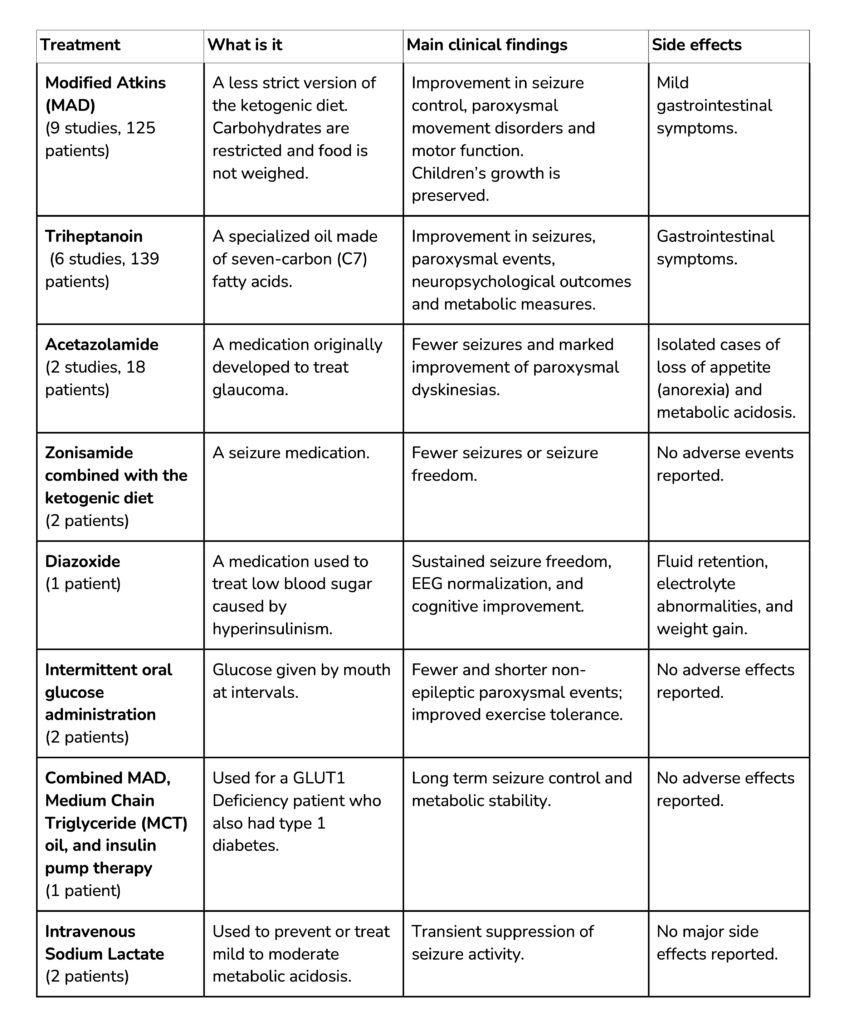
The modified Atkins diet had the strongest evidence of benefit among treatments reviewed. However, most of the studies and case reports included a small number of patients, which makes it difficult to draw firm conclusions about the benefits or side effects of these treatments.
Why is this publication important?
This systematic review bring together a substantial number of clinical trials, case reports, and observational studies that tested different treatments for GLUT1 Deficiency. Its importance lies not only in the information it compiles, which is very useful for patients, families, clinicians and researchers alike, but also on its reflection on how sustainable different treatments can be.
The authors make an important point: a treatment’s effectiveness should be judged not only by its clinical benefits, but also by its impact on the quality of life of patients and their families. They call this “metabolic quality of life”. It considers questions such as: How easy or how hard is the treatment to implement? Can the patient tolerate it? Is it sustainable? How much it impacts a family’s dynamic, social life and finances. All of those questions should be considered when prescribing a treatment.
According to the authors, one reason the modified Atkins diet works for so many patients is that, in addition to improving symptoms such as seizures, paroxysmal movement disorders, spasticity and others, it has has milder reported side effects. Most importantly, it works better in the real world. Because it is less strict than the classical ketogenic diet, it creates less psychological and social burden for the children, teens and adults following it. It is also easier for caregivers and patients to manage, which can give patients more independence and improve quality of life for patients and families alike.
What is important to consider?
Although this review analyzed a good number of publications, most of the results come from small studies or case reports. Because each treatment was tested in only a small number of patients, the results cannot be generalized to everyone living with GLUT1 Deficiency. This highlights the need for larger studies of potential treatments.
If symptoms persist, change or appear, it is critical to talk with your child’s neurologist or clinical team before making any treatment changes. Together you can decide whether trying a new option in appropriate. It is also important to understand what a new treatment involves: its benefits, its side effects, and the challenges of putting it into practice.
Take-home message
The authors raise an important idea: an individualized approach to treating GLUT1 Deficiency. Because symptoms and severity vary so widely among people living with GLUT1 Deficiency, individualized treatments maybe needed. This might not mean a different treatment for every person. Instead, it could mean matching certain types of treatment to people with certain symptoms, then adding other therapies as needed for each individual.
Finally, the authors emphasize that future research should go beyond the measuring seizure control and metabolic biomarkers. It should also include patient-centered outcomes such as treatment sustainability, caregiver burden, developmental impact and metabolic quality of life.
We thank Dr. Falsaperla, his team and collaborators for their work and their interest in helping our community!
Thank you for visiting our blog and please do not hesitate to contact me at sojeda@G1DFoundation if you have any questions.