Science with Sandra: Ketogenic diets during pregnancy and lactation


For this edition, I would like to highlight a recent publication by a team of clinicians practicing in the Ketogenic Dietary Therapy (KDT) field, many of them care for GLUT1 Deficiency patients, including Kelly Faltersack, Dr. Elizabeth Felton and Dr. Mackenzie Cervenka all of whom are esteemed members of our Scientific and Medical Advisory Board. Other esteemed members of our community who were also authors of this publication, include Dr. Tanya McDonald, Dr. Valentina De Giorgis, Dr. Elles Van der Louw and Dr. Marisa Armeno.
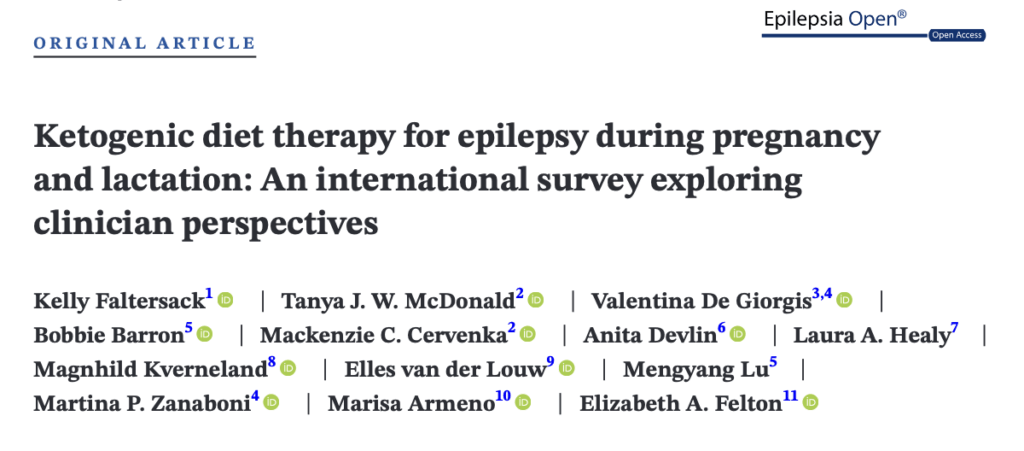
The title of the publication is: “Ketogenic diet for epilepsy during pregnancy and lactation: An international survey exploring clinician perspectives”. The goal of this publication was to collect international perspectives from healthcare professionals on the use of the Ketogenic Dietary Therapy (KDT) during pregnancy and lactation, both of which are nutritionally and metabolically complex periods. The survey asked healthcare providers about their experience with both GLUT1 deficiency and epilepsy as a group. Some providers shared that their perspective and approach may be different for individuals with GLUT1 deficiency.
THE STUDY METHOD
- International online survey distributed to clinicians and dietitians experienced in the KDT. The survey was shared between December 2023 and June 2024.
- There were 99 respondents, of which 35 had experience counseling pregnant patients on the KDT and 5 had counseled during lactation.
KEY FINDINGS
Ketogenic diet use during pregnancy
1. 60% of healthcare professionals did not recommend the KDT during pregnancy. The main concerns were:
- Lack of research and safety data
- Possible risks to fetal development
- Limited clinical experience and lack of dietitian support
2. Healthcare professionals who recommend the use of the KDT shared the recommended types of diet:
- Low Glycemic Index Treatment (LGIT) 38%
- Modified KDT 38%
- Modified Atkins Diet (MAD) 31%
- Modified LGIT 8%
- Classic Ketogenic Diet was not recommended during pregnancy
3. Most clinicians recommended regular monitoring of blood glucose and blood ketones, although there was no consensus on minimum and maximum thresholds.
4. Regarding diet composition, there was no agreement on specific macronutrients (carbohydrate, protein, fat) levels. Some healthcare professionals recommended individualized approaches regarding macronutrient intake during pregnancy.
5. Nearly all healthcare professionals who participated in the survey recommended supplements during pregnancy including folic acid, prenatal vitamins, vitamin D and calcium and to a lesser extent, carnitine and docosahexaenoic acid (DHA).
KETOGENIC DIET USE DURING LACTATION
- 54% (7/13) of healthcare professionals who recommended the use of the KDT during pregnancy, had been approached about using the diet during lactation. 71% of them provided counseling on diet adaptation during lactation.
- Continuation of the KDT was advised during lactation. The recommended diets were MAD (60%), LGIT (40%), CKD (20%), modified KDT (20%) and modified LGIT (20%). Some healthcare professionals recommended more than one type of diet.
- Regarding macronutrient intake, more flexibility was encouraged. Overall, an individualized approach regarding the minimum and maximum values of macronutrients was recommended.
- It was recommended to monitor blood ketones regularly during lactation.
- The majority did not recommend to monitor blood glucose regularly during lactation.
- Most of the survey participants recommended monitoring urine ketones during lactation.
- Recommended supplements during lactation include folic acid, calcium, vitamin D and prenatal vitamins. Electrolytes and DHA were less commonly recommended.
The authors offered additional insights of these metabolically complex periods. They mentioned that during pregnancy ketosis is typically accelerated, especially in the first trimester, and that the level of carbohydrate restriction that induces ketosis during pregnancy is unknown.
According to the authors, a few case reports in humans show positive outcomes, including a case about a child with GLUT1 Deficiency developing normally after the mother continued the KDT during pregnancy. After birth, the newborn was diagnosed with GLUT1 Deficiency and the child was started and maintained on the KDT.
Finally, the authors emphasized that patient enrollment in pregnancy registries, specially those that capture the use of the KDT, is key to learn more about the safety of the KDT so that healthcare professionals as well as patients using the KDT for their treatment can make more informed decisions about their treatment plans.
We thank all the authors of this publication for all the work they put into this wonderful study and for caring about our community!