Gaps in data for using ketogenic diets in Glut1 Deficiency

Hello and welcome to Science with Sandra. I hope you had a wonderful summer!
For this month’s edition, I would like to highlight a publication on the ketogenic diet. The title of the publication is “The use of ketogenic diets in children living with drug-resistant epilepsy, glucose transporter 1 deficiency syndrome and pyruvate dehydrogenase deficiency: A scoping review”. This publication was written by Tracy Cameron, a pediatric dietitian from the Royal Aberdeen Children’s Hospital in Aberdeen, Scotland.
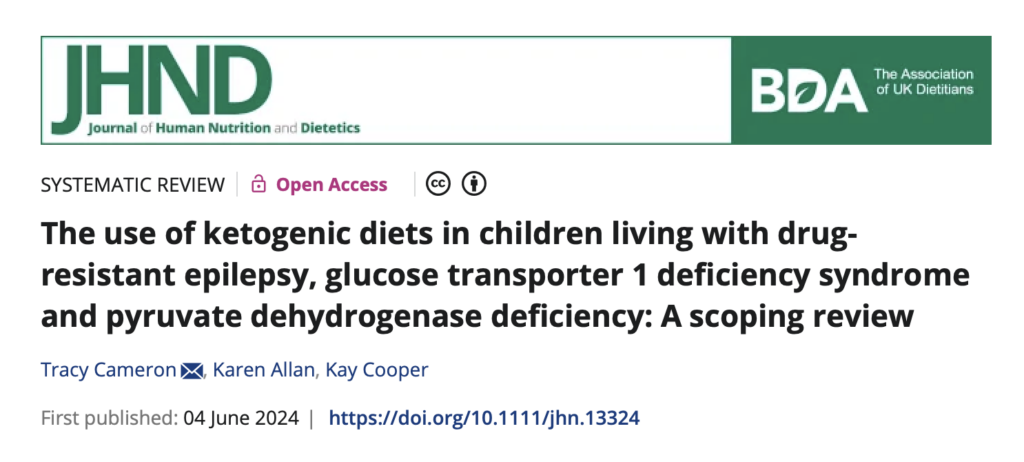
The aim of the review was to provide a comprehensive map of evidence-based research on ketogenic diets, with a focus on drug-resistant epilepsies and associated metabolic conditions to summarize the current knowledge and identify the gaps in knowledge.
The main question the authors had was, what research has been conducted on the use of the ketogenic diet in children with drug-resistant epilepsy, GLUT1 Deficiency Syndrome and Pyruvate Dehydrogenase Deficiency (PDHD)?
To review was done on studies in patients 18 or younger performed in any geographical location and in any setting. The authors analyzed different databases and looked for relevant studies published in the English language from September 2021 to February 2024. 320 out of 4703 studies met the inclusion criteria for this review.
The results showed that most of the studies the authors analyzed were retrospective, which means that the studies looked back in time at the patient health history, in this case, in relation to the use of the ketogenic diet. Most of the studies took place in the United States and most of the studies researched the use of the classical ketogenic diet.
The authors report that with regards to GLUT1 Deficiency, only 5% of the studies focused on this condition. Most of the studies reported for GLUT1 Deficiency were case reports, followed by retrospective studies. Some of the studies reported patients reached complete seizure freedom, while others reported seizure freedom at around 80%. Some of the reasons listed for poor outcomes included poor ketosis, patients diagnosed at an older age, and side effects of the ketogenic diet. In addition, parents of children living with GLUT1 Deficiency had impaired global scores for quality of life but this was comparable with other chronic diseases.
The authors suggest that the reason behind the fewer studies published in rare metabolic conditions such as GLUT1 Deficiency is due to the smaller patient population and challenges recruiting patients for the studies. Additionally, one of the key findings that the authors describe is that there is less evidence available on GLUT1 Deficiency and Pyruvate Dehydrogenase Deficiency. The studies showed that the ketogenic diet was seen as beneficial by improving seizure activity and movement disorders. The authors point out that despite the lower amounts of evidence, the ketogenic diet is the current standard care of treatment for GLUT1 Deficiency.
Finally, the authors consider there are gaps in knowledge with regards to the use of the ketogenic diet in children living with rare metabolic conditions such as GLUT1 Deficiency. They think that single case studies about the use of the ketogenic diet in children living with this condition as well as PDHD along with additional prospective studies would provide quantitative data to increase the evidence to consider the use of the ketogenic diet for these conditions.
The authors believe there is also a gap on the number of qualitative studies with regards to the experiences of patients and families around the ketogenic diet as a treatment.
I would add that it would also be important to add more case studies or prospective studies of adult patients in the GLUT1 Deficiency community who are treated with the ketogenic diet. There is still a big need for guidance on this front.
With regards to the qualitative studies, I believe that patients and families in the community who are currently using the ketogenic diet to treat this condition, who used it in the past, or at least considered using it, play an important role for qualitative studies to take place. We, as patients and family members can participate in surveys, including the natural history study, share our experiences and share the difficulties around the diet or the benefits of the diet. When we don’t share this valuable information, it is difficult for physicians, dietitians and researchers to understand individual experiences and to help improve compliance or to develop better treatments that will help address the needs and priorities of patients to improve their quality of life.
I would like to thank Tracy Cameron and the team who worked on this publication for shining a light on the knowledge and gaps on knowledge around the ketogenic diet used to treat patients in the GLUT1 Deficiency Community.
Thank you for reading this post and please do not hesitate to contact me if you have any questions at [email protected].
Related Posts