
GLUT1 Deficiency Outside of the Brain

Hello and welcome to Science with Sandra!
For this edition I would like to highlight a new publication by Dr. Abraham Al-Ahmad and his team. Dr. Al-Ahmad is an Assistant Professor of Pharmaceutical Sciences at Texas Tech University and a esteemed member of our Collaborative Research Network.
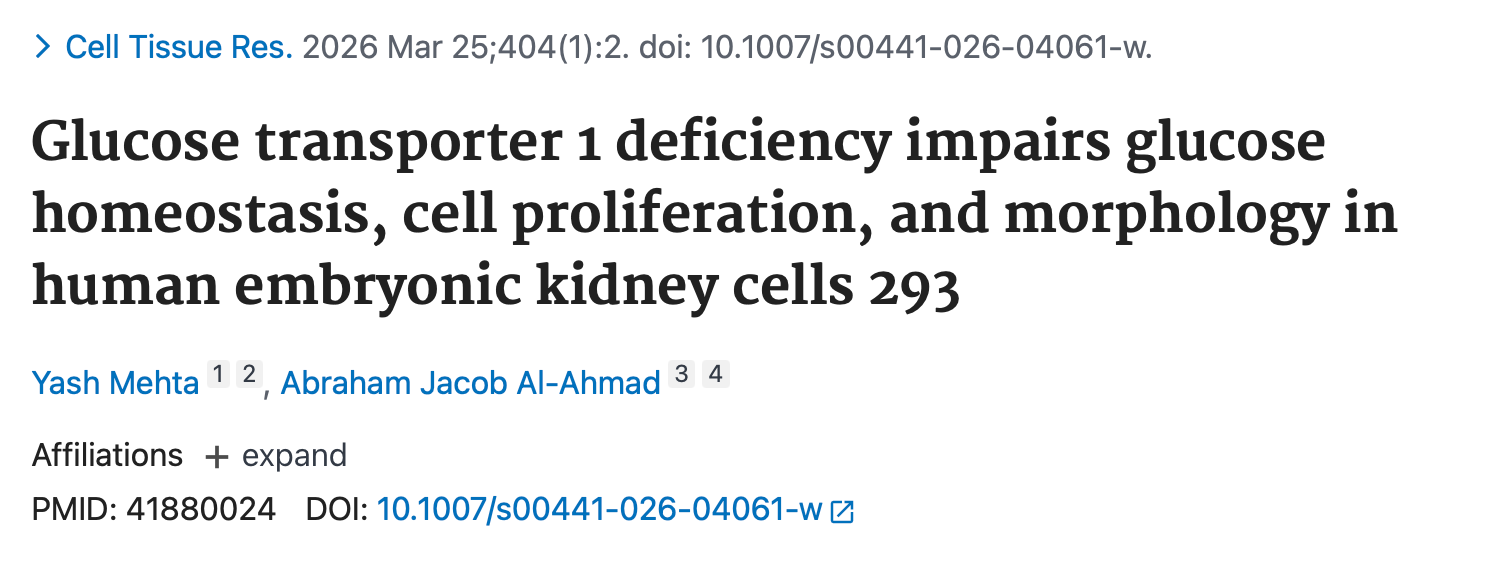
The title of his most recent publication is: “Glucose transporter 1 deficiency impairs glucose homeostasis, cell proliferation, and morphology in human embryonic kidney cells 293”.
Purpose of the study
This study aimed to understand how the loss of GLUT1 affects non-brain cells, using a commonly studied human cell line (kidney cells called HEK293). The goal was to see how these cells respond when they cannot efficiently take in glucose.
What Did the Researchers Do?
The researchers created a special version of these cells where the GLUT1 protein was disrupted (or “knocked out”). They then compared these cells to normal cells by measuring:
- Glucose uptake (how much sugar enters the cells)
- Energy production
- Cell growth and shape
- Activity of metabolic pathways (how cells process energy)
Key Findings
1. Cells could survive but were struggling
Even without GLUT1, the cells did not die. However, they showed clear signs of stress:
- Slower growth
- Changes in shape and movement
- Reduced overall activity
2. Glucose uptake was significantly reduced
Cells without GLUT1 could take significantly less glucose than control cells.
Importantly, other glucose transporters such as GLUT2, GLUT3 and GLUT4 were not observed to compensate for this loss. This means GLUT1 plays a unique and critical role.
3. Impaired glucose metabolism
- Glycolysis, the process cells use to breakdown glucose collapsed in HEK293 cells deficient in GLUT1 protein.
- These cells produced much less ATP, about 60% less than control cells. This indicates that mitochondrial function was also affected.
4. Cells switched to a backup survival pathway
The cells activated an alternative pathway called the pentose phosphate pathway (PPP).
This pathway:
- Helps protect cells from stress
- Produces molecules that combat damage (oxidative stress)
However, this pathway cannot fully replace normal energy production.
5. Cell growth and morphology changed
HEK293 GLUT1-deficient cells:
- Divided more slowly (about 40% slower)
- Became thicker and more rounded
- Moved less efficiently
These changes suggest the cells were showing signs of cellular distress.
Why is this important?
1. Broader understanding of GLUT1 Deficiency
This study shows that GLUT1 deficiency affects not only brain cells but also other cell types. This helps explain why the disease has wider effects in the body, for example not only affecting the nervous system but other body systems.
2. Energy failure in cells
The research demonstrates that:
- Without GLUT1, cells cannot maintain normal energy production
- Backup systems are not enough to compensate
This helps explain symptoms seen in patients, especially in tissues that demand a high amount of energy like the brain.
3. A new tool for future research
The engineered cell model created in this study provides a powerful platform to:
- Study different mutations in the SLC2A1 gene that affect the GLUT1 protein
- Test potential treatments
- Understand how the transporter works at a deeper level
Take-Home Message
GLUT1 is essential for delivering glucose into cells and maintaining energy production. When it is not functioning:
- Cells cannot take in enough glucose
- Energy production collapses
- Growth and function might be impaired
- Cells activate emergency pathways but these might not be sufficient
This study provides important insight into how GLUT1 deficiency disrupts cellular energy and offers a valuable tool for future research into treatments.
We thank Dr. Al-Ahmad and his team for all their work in this study and for his continued support to our community!
Thank you for visiting our blog and please do not hesitate to contact me at [email protected] if you have any questions.
Related Posts