New Study Highlights the Potential of Decanoic Acid in GLUT1 Deficiency

Hello and welcome to Science with Sandra!
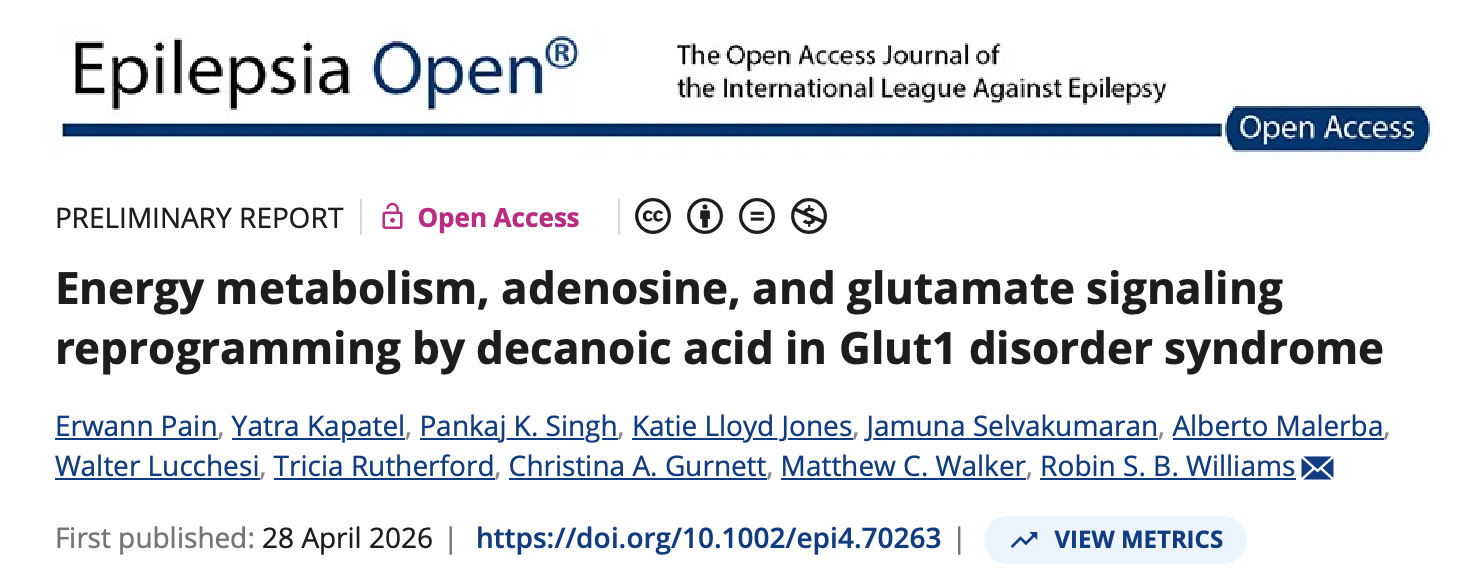
For the June edition of our blog, I would like to highlight a recent publication by Dr. Robin Williams and collaborators. Dr. Williams is a Professor of Molecular and Cell Biology at Royal Holloway, University of London, an active member of our community, a member of our Medical and Scientific Advisory Board, and one of the co-leaders of our Research Tools Scientific Working Group.
The title of the publication is “Energy Metabolism, Adenosine, and Glutamate Signaling Reprogramming by Decanoic Acid in GLUT1 Deficiency Syndrome.”
What Was the Goal of the Study?
The goal of this study was to investigate the role of medium-chain fatty acids, specifically decanoic acid (DA) and octanoic acid (OA), as well as an 80:20 blend of DA and OA that is similar to that used in a recent clinical trial. The researchers sought to identify how these fatty acids may regulate gene expression in GLUT1 Deficiency and how they may influence metabolic reprogramming.
How the study was done?
Researchers used induced pluripotent stem cells (iPSCs) derived from a person with GLUT1 Deficiency.
These cells were treated with:
- DA alone
- OA alone
- An 80:20 mixture of DA and OA (similar to the formulation used in the clinical trial)
Importantly, the experiments were conducted under high-glucose conditions. This allowed the researchers to identify changes caused by the treatments themselves rather than by glucose restriction.
They then examined how the expression of thousands of genes changed in response to the different treatments.
Key Findings
Changes in gene expression
The expression of thousands of genes was significantly altered, with the greatest effects observed in response to the DA:OA treatment.
Interestingly, DA-containing treatments increased the expression of genes involved in energy metabolism. At the same time, they decreased the expression of other genes, including several neurotransmitter receptor genes.
DA-containing treatments mimic ketogenic diet energy metabolism reprogramming
In GLUT1 Deficiency patient-derived iPSCs, DA-containing treatments produced effects similar to those observed with the classical ketogenic diet, even under high-glucose conditions.
Specifically, these treatments:
- Reduced reliance on glucose
- Increased fat metabolism
- Enhanced mitochondrial energy production
As a result, the cells showed changes consistent with a shift toward increased fat utilization state without requiring strict dietary carbohydrate restriction. This mimics some of the metabolic effects of the ketogenic diet in a potentially more flexible way.
DA-containing treatments may improve brain energy production
The treatments increased the expression of genes involved in important energy-producing pathways, including:
- β-oxidation (fat metabolism)
- The tricarboxylic acid (TCA) cycle, a central energy-producing pathway
- Oxidative phosphorylation, which is essential for ATP production
These findings suggest that the brain may be able to generate energy more efficiently, even when glucose transport is impaired.
DA-containing treatments regulate adenosine metabolism
Adenosine is an inhibitory neuromodulator that helps calm brain activity and reduce neuronal overexcitability. By influencing adenosine metabolism, DA-containing treatments may help reduce seizure activity.
Potential effects on glutamate signaling
DA-containing treatments may also indirectly affect glutamate signaling through changes in the expression of synaptic neurotransmitter receptors.
Glutamate is the brain’s primary excitatory neurotransmitter. The findings from these GLUT1 Deficiency patient-derived iPSC studies suggest that DA-containing treatments may help control seizures associated with excessive glutamate-mediated excitatory signaling.
Why is this study important?
This study suggests that:
- A less restrictive dietary approach containing decanoic acid may provide benefits similar to those of the ketogenic diet.
- Treatment strategies including high decanoic acid may not require strict carbohydrate restriction to achieve some of the metabolic effects associated with ketosis.
- New therapeutic approaches may emerge for managing seizures in individuals with GLUT1 Deficiency.
We thank Dr. Williams and his collaborators for their work on this project and for their commitment to developing better treatments for the people affected by GLUT1 Deficiency in our community.
Thank you for visiting our blog! If you have any questions, please feel free to contact me at [email protected].