Neurological Glycogen Storage Diseases and Emerging Therapeutics


Hello and welcome to Science with Sandra! On this occasion I would like to share a brief summary of a publication from Dr. Matthew Gentry and his team. The title of the publication is: “Neurological glycogen storage diseases and emerging therapeutics”. As you may know, Dr. Matthew Gentry is the Scientific Advisor for the Glut1 Deficiency Foundation and an esteemed member of the Scientific and Advisory Board. Dr. Gentry is chair of Biochemistry and Molecular Biology in the College of Medicine at University of Florida and he is a prominent brain metabolism scientist who has made seminal discoveries in the field of brain glycogen and glucose metabolism and how perturbations in these pathways impact neuro-centric diseases.
The publication mentioned above is an overview of perspectives on neurological glycogen storage diseases (n-GSD), focusing on recent advances in understanding their molecular basis, development of therapeutics, challenges, and how these efforts need to be addressed to have a better understanding of the pathogenesis of the diseases to deliver better therapeutics to the patients.
Glycogen storage diseases or (GSD) are a group of inherited metabolic disorders characterized by defects in glycogen metabolism, which leads to abnormal glycogen accumulation in multiple tissues. According to the authors, recent studies have identified the importance of glycogen metabolism in the brain in several physiological functions, and when this metabolism is disturbed, it leads to diseases of the central nervous system.
The authors begin explaining glycogen – it is the main carbohydrate storage molecule in organisms ranging from bacteria to animals. It’s made of glucose molecules that are linked together and that make branches. This branching helps to maintain its solubility and allows its rapid synthesis and degradation depending on the metabolic needs. (See figure below).
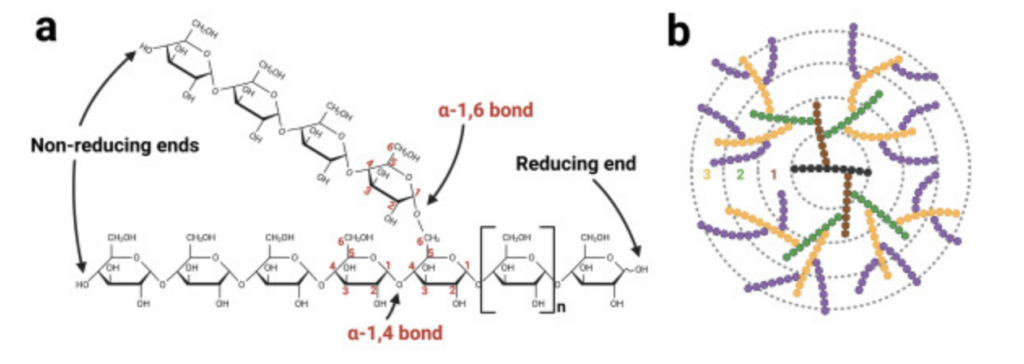
Coulpaert, M. et al. 2024
What is the importance of glycogen in the brain?
Authors describe how brain is an organ with high energy demands and consumes about 20% of the body’s total energy. In addition, they point out that during development, the brain energy demand is about 60% and additionally 50% of total body metabolic rate in neonates and children.
Studies in this field have found that glycogen plays an important role as an emergency reserve as well as a role in normal brain physiology. One example is the that glycogen derived from glucose metabolism in the brain supports the balance of two major neurotransmitters – glutamate and GABA. In addition, glycogen is an essential player in the metabolic interactions between astrocytes and neurons and in the production of glycogen-derived lactate that is necessary for neurons.
Glycogen is distributed throughout the brain. In human brain, glycogen is enriched in the gray matter of the cortex, as well as in granular layers of hippocampus and cerebellum. Astrocytes are responsible for the majority of glycogen stores in brain, and it is highly accumulated in the perivascular endfeet and in processes interacting with presynaptic terminals (see figure below).
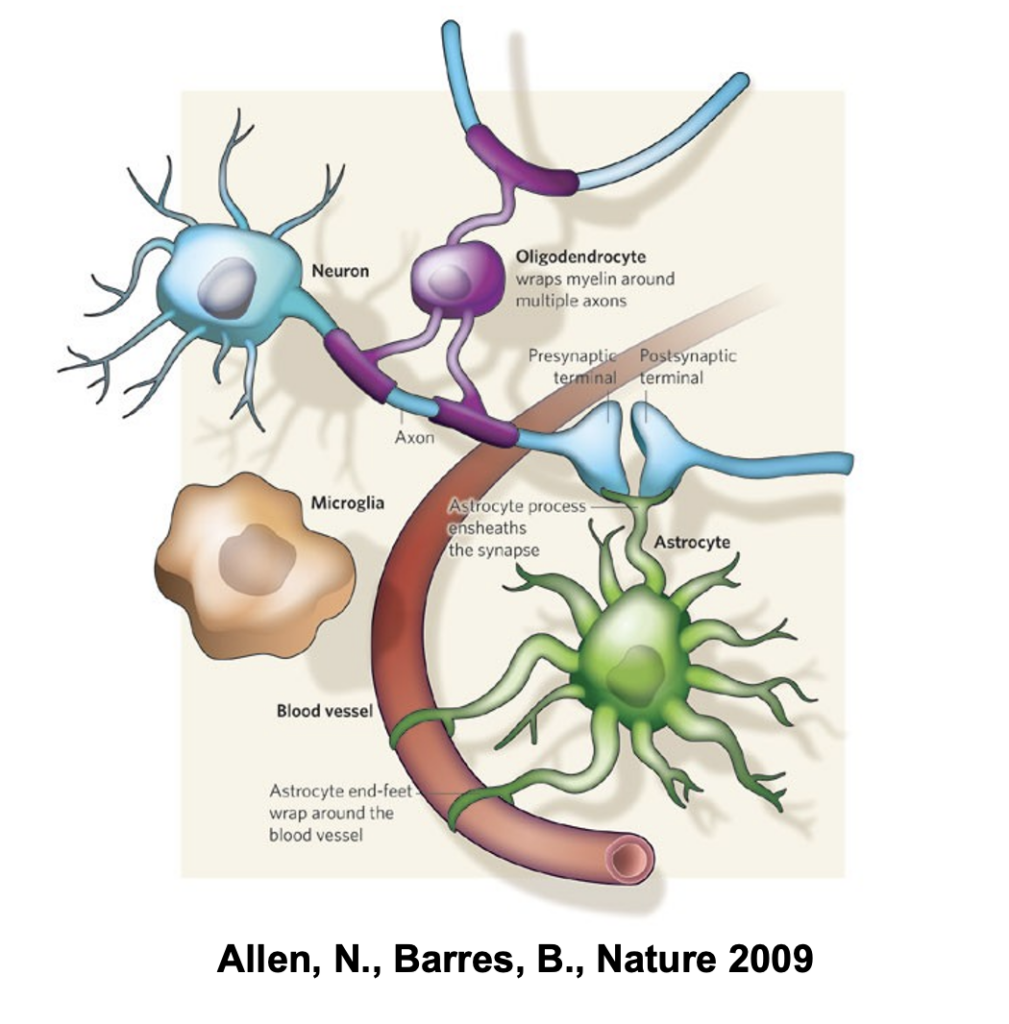
Allen, N., Barres, B., Nature 2009
Next, the authors describe the neurological glycogen storage diseases (n-GSDs) which include Lafora disease (LD), Adult polyglucosan body disease (APBD) and Pompe Disease. All these diseases have in common an accumulation of glycogen in different tissues.
Additional to the diseases mentioned above, there is a set of emerging n-GSD including two types of glycogen storage diseases (type 0b and type III), and RBCK1-associated polyglucosan body myopathy type 1, which show an increased glycogen accumulation in different tissues. In addition, the authors add Glut1 Deficiency to this list. In contrast to the other diseases mentioned, in the case of Glut1 Deficiency, mice studies have shown that in this disease there is a reduction in brain glycogen accumulation.
Dr. Gentry and his team describe a substantial list of strategies that are being pursued to treat n-GSDs including enzyme replacement therapy; antibody enzyme fusions; intracerebroventricular administration of therapeutic agents, which can bypass the blood brain barrier allowing a broad distribution of the agent throughout the brain; gene therapy, and other alternative strategies such as treatments using small molecules.
Finally, the authors list some of the challenges for therapy development for n-GSDs. Some of the challenges include:
- Identifying the brain/CNS regions that are primarily affected in these diseases
- Identifying the cell types involved in glycogen accumulation, and I could add, the reduction of glycogen
- How does glycogen distribution change in brain regions in n-GSDs?
- What is the region and/or cell type-specific molecular/metabolic signatures linked to perturbed glycogen metabolism in n-GSDs?
We thank Dr. Gentry and his team and collaborators for opening the possibility of including Glut1 Deficiency in this groups of conditions in which glycogen metabolism is disrupted, as it increases the possibilities to develop more and better treatments for patients in our community. We’re so thankful for his commitment.
Thank you for visiting our blog and please do not hesitate to contact me if you have any questions at [email protected].