Recent NIH grants for GLUT1 Deficiency Research

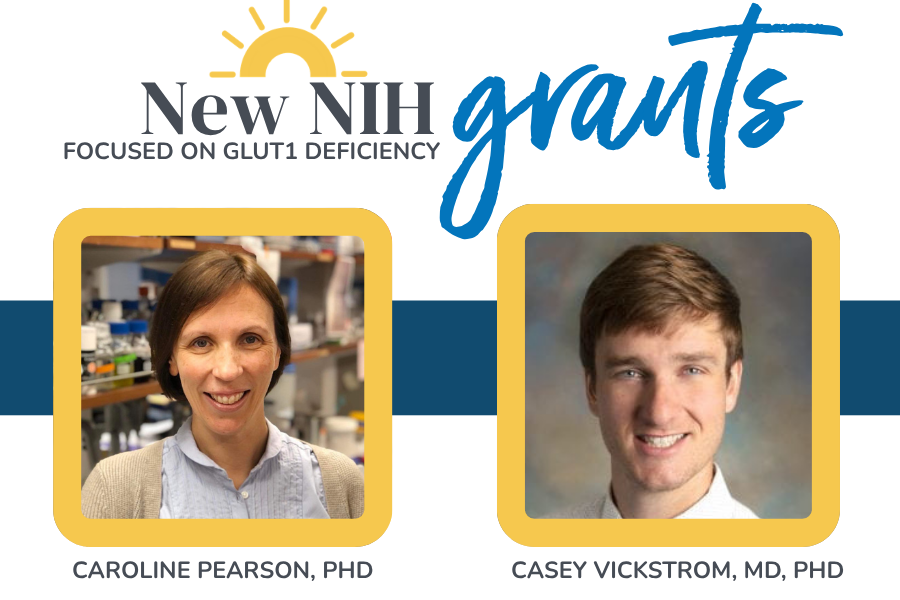
We are thrilled to share exciting news from the GLUT1 Deficiency research community as two investigators, Dr. Caroline Pearson and Dr. Casey Vickstrom, have recently received NIH funding to support projects focused on GLUT1 Deficiency.
Securing NIH funding is an extraordinary accomplishment that reflects not only scientific merit and innovation, but also immense dedication, perseverance, and countless hours of hard work. From developing research ideas and building collaborations to writing and refining highly competitive grant applications, this process represents a major commitment to advancing science and improving lives.
We are deeply grateful to Dr. Pearson and Dr. Vickstrom for their interest in GLUT1 Deficiency and for the passion and expertise they are bringing to this field. Their work represents important momentum for our community, and we are excited to celebrate this achievement and share more about the projects they will be leading.
Caroline Pearson, PhD
Weill Cornell Medicine
R01 Grant Project Title: Determining the Role of Glucose Transporter 1 in Neural Development and Disease
What is the focus of your grant?
The grant focuses on determining the role of GLUT1 in brain development. We found that GLUT1 is expressed in neural stem cells, so we asked how loss of GLUT1 might affect their trajectory and the cell types they give rise to, including neurons and astrocytes. We are using mouse and human models of development and hoping to determine how loss of GLUT1 in neural stem cells contributes to GLUT1 Deficiency Syndrome.
What impact will this study have on the GLUT1 Deficiency community?
We hope that this study will give us increased insight into the function of GLUT1, how GLUT1-deficient brains develop, and ultimately identify targetable pathways that represent therapeutic avenues.
What are you most excited about regarding this work?
I am most excited about expanding our understanding of GLUT1 during neurodevelopment to better understand the non-seizure-related symptoms of GLUT1-DS. I’m also excited about discovering new roles for GLUT1, beyond its role as a glucose transporter.
Project Summary:
The brain is built by neural stem cells, which reside in niches that regulate when and where nerve cells are born. Our work aims to understand how environmental signals influence the decisions neural stem cells make, for instance, when to generate a nerve cell, and how this affects the long-term development and function of the brain. This funding will focus on how neural stem cells are impacted when they don’t express GLUT1 and cannot take up glucose. We hope to discover how the brain develops when it lacks sufficient GLUT1 and which developmental pathways are affected. If we better understand how GLUT1-deficiency affects brain development, we can gain new insights into the basis of GLUT1 Deficiency Syndrome, and potentially how to improve treatments.
Casey Vickstrom, MD, PhD
Washington University | St. Louis Children’s Hospital
UE5 Grant Project Title: Targeting Negative RNA Regulatory Elements with Antisense Oligonucleotides as a Novel Therapeutic Strategy for GLUT1 Deficiency Syndrome
What is the focus of your grant?
The focus of my grant is to develop a new therapy for GLUT1-DS using antisense oligonucleotides (ASOs). ASOs are short, synthetic DNA molecules which interact with mRNAs to modulate the expression of specific proteins. The goal is to develop ASOs which would restore more of the GLUT1 transporter and therefore pump more glucose into the brain. This would work by interfering with negative regulatory elements in the SLC2A1 mRNA (which encodes GLUT1 protein) which would stabilize mRNA, promote its longevity, and enhance protein translation. We plan to test a panel of ASOs in cell culture reporter systems, patient-derived stem cells, and animal models. Simultaneously, we will study the molecular regulation of SLC2A1 mRNA and profiles of patient-derived stem cells to better understand GLUT1-DS biology.
What impact will this study have on the GLUT1 Deficiency community?
My ultimate hope is that ASOs could be a treatment option for patients with GLUT1-DS, either in combination with the ketogenic diet or even as a replacement of it.
What are you most excited about regarding this work?
I am very excited to see if ASOs can be a new treatment for GLUT1-DS. If successful, there is a very real opportunity to move these into clinical trials. I am also excited to be able to obtain stem cells from patients with GLUT1-DS to test ASOs in and to better understand the biology of the disease, which may inform other new avenues for treatment.
Project Summary:
This grant aims to develop a new treatment for GLUT1-DS. The goal is to restore more of the GLUT1 transporter to pump more glucose into the brain. This new treatment is a type of gene therapy using what is called antisense oligonucleotides (ASOs), which are short synthetic DNA molecules that stick to mRNA, which are the blueprints for proteins. For this grant, we are developing ASOs that stick to and block parts of the GLUT1 mRNA that cause the mRNA not to work fully or to break down prematurely. With this treatment, the mRNA would stick around longer and be better at making GLUT1 protein. This is promising as the problem for most people with GLUT1-DS is that one copy of the gene does not work well, and the other normal copy cannot fully compensate for the other damaged copy. This treatment would boost the amount of protein made from the normal copy to hopefully return the GLUT1 protein to normal levels. We will use cell models and stem cells from patients with GLUT1-DS to test new ASOs to see which ones work best. Along the way, we will study how different parts of the mRNA impact how GLUT1 protein is made, and study how stem cells from patients with GLUT1-DS differ to better understand the biology of the disease.