Research Roundtable Summary Winter 2025

Hello everyone and welcome to Science with Sandra!
For this edition I would like to share a summary of our most recent Research Roundtable that took place on Tuesday January 21st. We had great participation, 29 participants including researchers, clinicians and a few parents from all over the world. For this meeting Glenna Steele, our Executive Director, share some updates from the G1DF and I shared preliminary results of our Matrix Natural History Study.
First, Glenna shared the goals of the G1DF for this new year, which include:
- fund clinical trials for two potential new treatments
- complete the puberty experiences in Glut1 Deficiency research project
- develop additional open source disease models for research
- host our first Research Workshop to tackle collaborative projects and topics
- launch a new international patient registry/census
- establish a Center of Excellence program for model clinical care
- launch a new support program to help navigate school experiences
- launch a new parent peer support program for mentoring and connection
The first goal is to fund clinical trials for two potential new treatments. The first trial will be funded through the Team Glut1 grant through the Million Dollar Bike Ride (MDBR). Dr. Paul Thornton was awarded the grant from Penn Medicine Orphan Disease Center. Dr. Thornton is leading global expert for congenital hyperinsulinism, another rare genetic disorder. He is the director of the Endocrinology Department at Cook Children’s Medical Center in Fort Worth, Texas. The title of his project is: “Does treatment with Diazoxide elevate the plasma glucose levels in GLUT1 Deficiency Syndrome thus potentially increasing glucose transport across the blood brain barrier?”
Diazoxide is a medication used to treat low blood sugar (hypoglycemia) caused by hyperinsulinism. Diazoxide has been used in Glut1 Deficiency patients and there is a case report published by Dr. Santhi Logel, Dr. Ellen Connor, Dr. Darryl De Vivo, and team. The case reports the experience of a Glut1 Deficiency patient who did not respond well to the ketogenic diet and was treated with diazoxide and responded well. Dr. Thornton was present during the research roundtable and expressed his gratitude for receiving this grant and was excited to work together with the whole community to help our patients. The trial will likely start closer to summer and will have two clinical trials sites located at Cook Children’s Medical Center in Fort Worth, Texas and at the University of Wisconsin in Madison with Dr. Ellen Connor.
We are planning a virtual meeting open to everyone in our community where Dr. Thorton will be the guest speaker and will share more details about the study and how to participate. We will let you know once we have a date for this meeting.
The second trial Glenna shared at the research roundtable will involve the use of fucose supplementation for Glut1 Deficiency adult patients. The trial will be led by Dr. Rodrigo Starosta, a clinical and biochemical geneticist at Oregon Health and Science University (OHSU) in Portland, who has experience caring for patients in the Congenital Disorders of Glycosylation (CDG) community and who has treated a patient in that community using fucose. Dr. Starosta has teamed up with Dr. Hudson Freeze and Dr. Matthew Gentry to make this trial a reality. Dr. Freeze discovered that fucose is also transported by GLUT1, and Dr. Gentry, is our science advisor and is a leading expert in glycogen and diseases impacted by it.
But what’s fucose? Fucose is a monosaccharide, or simple sugar, that’s found in many organisms, including humans, plants, and brown algae. Fucose is involved in various biological processes, including regulating inflammatory responses, cell growth, cell-to-cell recognition, immune function, development and gut health. Fucose is incorporated into proteins through a process called fucosylation, which plays a role in protein structure and function.
Dr. Gentry, together with Dr. Freeze and Dr. Pascual, conducted experiments in Glut1 deficient mice using fucose supplementation for 10 days. Analysis previous to the supplementation showed that Glut1 Deficient mice have decreased brain glycogen, and decreased glycosylation in comparison to healthy mice. Results after the supplementation showed that Glut1 Deficient mice that received fucose had increased brain glycogen levels, as well as increased fucosylation levels, and in addition, mice showed improved motor skills.
The clinical trial site where Dr. Starosta will conduct the study, is the Oregon Health and Science University (OHSU) in Portland, however, it is possible that additional clinical trial sites will open later.
We are also planning a virtual meeting open to everyone in our community, where Dr. Starosta will be the guest speaker and will share more details about the study and how to participate. We will let you know once we have a date for this meeting.
Other initiatives the G1DF is working on include an international patient registry/census where we will collect basic information about location, symptoms, treatments and priorities. To establish a Center of Excellence is one of our goals; this will provide a model of care, where a coordinated teamwork approach will provide care and services to patients in our community. Ideally, this center will have a research component and a built in clinical trial site. We will be working on this planning at our Research Workshop this summer.
In addition to the support programs already established by the G1DF such as the Keto Care Project, the Bright Horizons Project, the Community Connect Facebook group, and the Glut1 Gatherings on Zoom. We will start a school support and a parent mentor programs. All of these with the goal to offer a more holistic support approach to the community.
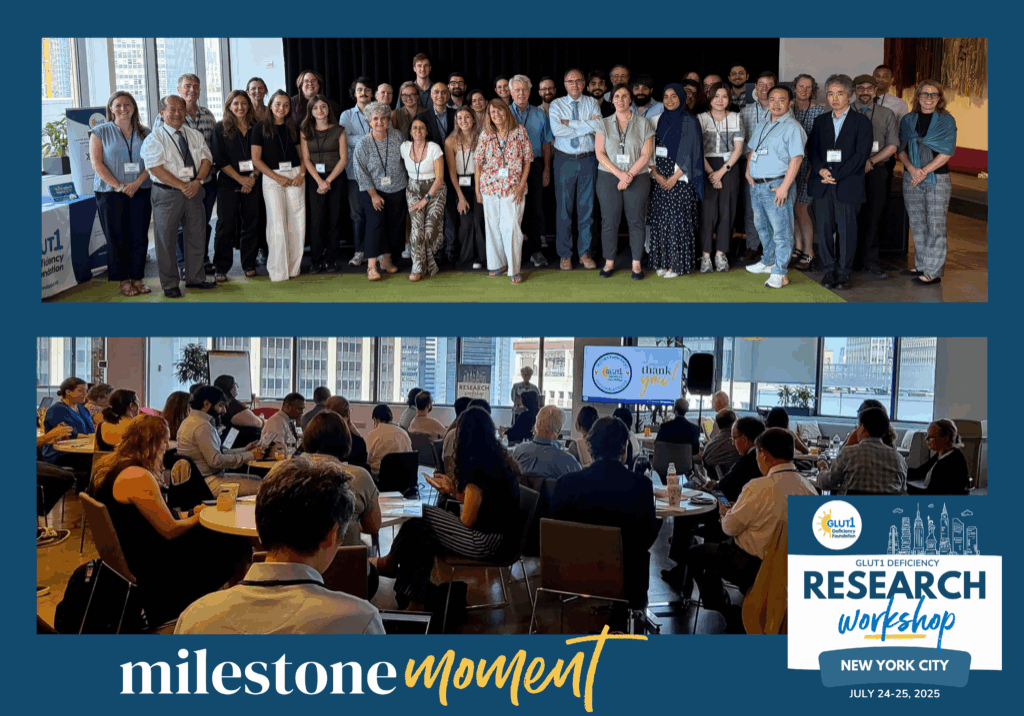
On the research field, besides providing support for future clinical trials, we want to continue providing a space for researchers and clinicians to meet, share and learn through our research roundtable gatherings. In our efforts to make the most out of these meetings and the time participants have to spend with us, we have decided to change the format. Instead of meeting quarterly, we will meet only twice a year. The plan is to host one winter virtual meeting and one in person meeting every summer alternating between our conference and a research workshop. The first research workshop will launch this July 24-25, and the aim is to bring together researchers and clinicians on a mission to drive scientific progress and to improve patient care.
This meeting is geared towards professionals at any career stage who share our commitment to building a brighter future where Glut1 Deficiency will be easy to diagnose early, treat effectively and cure completely. You can find more information about this meeting following this link.
The second part of the research roundtable focused on the preliminary results of our Matrix Natural History Study. This study is a patient-reported data collection project on the Matrix platform which is possible through our COMBINEDBrain membership with other rare disease organizations. This platform provides a secure place to share information about the unique experiences of the patients in our community regarding symptoms and medical history.
The goal of this study is to help understand the individual experiences of people who have this disease so researchers can better understand its impact on patients and how that may change over time. The insights collected from patient-reported surveys on the matrix platform, will be critical for developing new and better ways to diagnose and treat Glut1 Deficiency.
At this time, I would like to give you a snapshot of the results shared at the research roundtable. As I mentioned earlier, the data shared is just preliminary, and more patient participation is needed in order to make conclusions.
Currently, there are 50 patients enrolled from all over the world. Most participants are located in the US, but we also have participants from Canada, Spain, Peru, Argentina, Australia, the UK and Belgium.
Below you can see a snapshot of the study demographics:

The majority of surveys have been completed by parents or caregivers representing their affected children. Most represented patients are females and most of the patients participating are adults.
Regarding genetic data collected in the study, the results indicate that the majority of participants have received genetic testing. The most common type of variant reported on the SLC2A1 gene, which encodes the GLUT1 protein, are missense variants. In addition, there are reports of patients who have variants of unknown significance (VUS) and patients who don’t have a variant on this gene but who have a low CSF glucose.
39 Participants in the study have responded to a brief survey about their ketogenic diet experience. The majority of participants report trying the ketogenic dietary therapy and the most common types used are the classic 3:1 to 4:1 ratio and the modified ketogenic diets which encompass ketogenic diets with lower ratios.
Among the first surveys participants respond when they join the study is the health and development survey, or the head to toe survey as we call it in our community. The purpose of this survey is to do a quick check up of all the systems in the body. When participants report issues with one of the systems asked, the survey delivers more questions related to that system.
The results of this survey show that most participants report experiencing issues with their brain and/or nervous system (96%), followed by issues with muscles (70%) and eyes and/or vision (61%). The most common issues reported with the brain and nervous system include coordination issues, cognitive impairment and seizures. Issues with the muscle system include muscle function, such as weakness, stiffness and involuntary movements. With regards to the eyes and vision, issues include abnormal eye movement, which although it was not specified, it could be related to the unusual eye head movements experienced early in infancy. Other vision issues include nearsightedness and blurry vision, among others.
The Natural History Study comprise surveys about development. Participants report their loved ones were delayed to reach developmental milestones such as seating alone (most common age was 9 to 12 months), taking first steps (most common age was after 24 months), first words (most common age was 10 to 14 months).
In summary, the population represented by the data is diverse. The data shows a broad spectrum of systems being affected in patients with Glut1 Deficiency, with the most commonly affected systems being nervous, muscular and vision. As expected, the developmental survey suggests a global developmental delay.
Finally, the data presented is just a glimpse of some patient reported data, however, the number of participants is too small to make any conclusions.
It is important to point out that some of the issues reported may or may not be caused by GLUT1 Deficiency, nevertheless, it is important to share this data with the scientific and medical community because it reflects the experiences and challenges patients and families in our community face each day and it may help drive future research projects. Therefore, more patient participation is needed in order to have more robust data that could potentially help the development of better treatments and eventually, a cure.
If you are a parent or caregiver of a patient with Glut1 Deficiency, and you want to share their experience and make it count, please, participate in this study. If your are interested in participating do not hesitate to contact me at [email protected] or go to our website where yo can find more information about this study, and where you can register, or if you prefer you can use this link to register.
If you are a clinician, please share more information with your patients about this study.
Thank you for visiting our blog and please contact me if your have any questions at [email protected].
Related Posts