
Science with Sandra – Impacts of Puberty


Hello and welcome to Science with Sandra!
I am really happy to share for this edition a new publication by Dr. Eric Kossoff in collaboration with the GLUT1 Deficiency Foundation. Dr. Kossoff is a professor of Neurology and Pediatrics at Johns Hopkins University in Baltimore, Maryland. His research and clinical practice focuses on the diagnosis and treatment of childhood seizures and epilepsy. He is currently the Medical Director of the Pediatric Ketogenic Diet Center at Johns Hopkins and he is also a member of our Medical and Scientific Advisory Board.
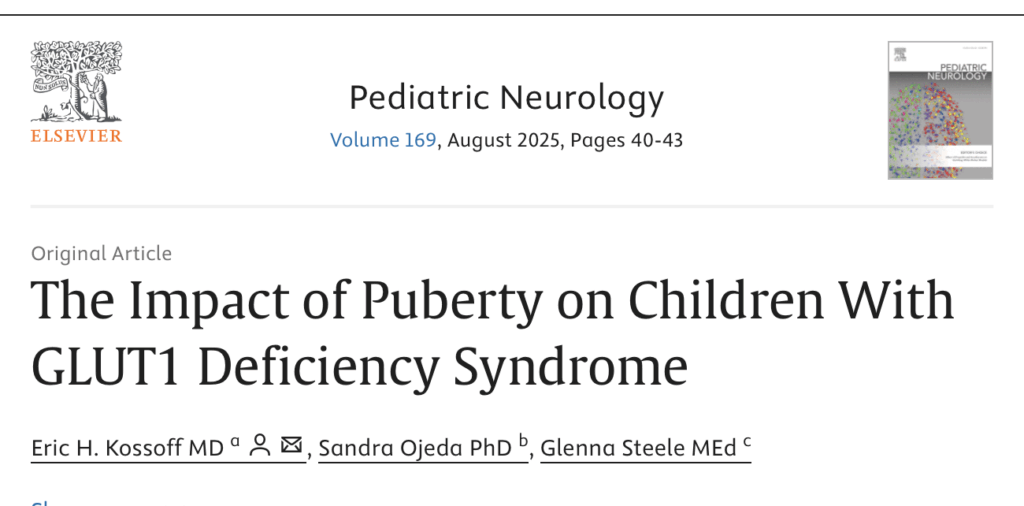
The name of the publication is “The impact of puberty on children with GLUT1 Deficiency syndrome”. The goal of this publication was to collect information about the experiences of patients in the GLUT1 Deficiency community during puberty, in response to concerns from parents about how this developmental stage might impact symptoms, as well as growing anecdotal reports of the significant difficulties some children with GLUT1 Deficiency face during this time. In addition, no published literature has specifically focused on the effects of puberty on GLUT1 Deficiency.
How Was the Study Done?
- A survey was shared online with the GLUT1 Deficiency community.
- 98 responses were collected from individuals with GLUT1 Deficiency who had gone through puberty.
- The survey asked about overall demographics, seizures, abnormal movements, other neurological symptoms including migraines and mood swings, and the effects of menstruation.
Key Findings
1. Demographics
● 98 surveys were completed.
- Participants included 33 male, 64 female, and one transgender male.
- Patients received a diagnosis at a mean of 7.2 years years of age.
- Puberty onset occurred at a mean of 12.4 years.
- Puberty occurred earlier in females (12 years) vs males (13.1 years).
- Average age of patients was 19.4 years at the time of the survey.
2. Seizures
- 38% said seizures got worse during puberty.
- 42% said they saw no change in seizures.
- Most of those who had more seizures added new medications including ethosuximide, lamotrigine and acetazolamide. Other medications reported included lacosamide, clobazam, valproate, levetiracetam and primidone. There was no information regarding effectiveness of those treatments.
3. Abnormal movements
- Movements worsened in 58% of respondents (more common than seizure worsening).
- Medications used for abnormal movements included acetazolamide, clonazepam, clobazam, piracetam, gabapentin, botulinum toxin and carbidopa-levodopa.
4. Other neurological symptoms
- Migraines or headaches were reported by 35% and were more common in girls.
- Mood swings and irritability were reported by 38%, with mood swings slightly more common in females than males.
- Other issues included fatigue, anxiety, academic difficulties, and acne.
5. Menstrual Effects
- 71% of participants experiencing menstruation reported that symptoms changed during menstruation. Most experienced worsening symptoms or new ones.
- There were reports of various difficulties during menstruation including heavy or unusual bleeding, irregular cycles, mood changes, or menstrual migraines.
- Those who were on the ketogenic diet saw lower ketone levels during their period.
6. Ketogenic Diet
- There was no dramatic increase in diet compliance or with diet side effects during puberty.
- The type of diet (classic ketogenic vs. modified Atkins) did not seem to affect symptoms, ketosis or compliance during puberty.
- Dr. Kossoff mentioned that according to the literature, the modified Atkins diet may be very effective for GLUT1 Deficiency patients, and even preferable for adolescents, due to increased compliance.
Quotes from patients and families
Survey participants were able to share additional comments with the study team. Dr. Kossoff shared some of those comments in the publication. You can find some of those below:
- “3 years of hell.”
- “This has been a difficult time for her and for us”
- “Puberty was a very difficult and complex time for me. Although my doctors and family did their very best, I felt very isolated and frustrated with my condition. These feelings continued into young adulthood.”
- “I became a lot more emotional, found interactions to explain my feelings at this time very challenging.”
- “It has been difficult for all the family. I think the biggest factor is the mood swings as she has little control.”
Conclusions
- There was not a clear indication of epilepsy worsening with puberty.
- Ketosis decreases with puberty for those on the KDT but it does not seem to necessarily lead to more seizures.
- Movement disorders seem to worsen during puberty.
- Migraines and mood changes were prevalent, but they are also common in the general population.
- A decrease in ketosis during the menstrual period was observed in half of the women participants in the survey.
- Women participating in the survey report experiencing changes in their symptoms during the menstrual period.
Finally, Dr. Kossoff concludes by saying that future prospective studies may further clarify the true incidence of puberty-onset symptoms and potentially lead to better treatments.
We thank Dr. Kossoff for spearheading this initiative and for collaborating with the GLUT1 Deficiency Foundation to shed light on the concerns of patients and families regarding the impact of puberty on our loved ones living with GLUT1 Deficiency.
Thank you for visiting our blog and please do not hesitate to contact me at [email protected] if you have any questions.